How Stouffville improved municipal service request resolution times by 37%
Smaller municipalities are often expected to do more with less. Tasked with enhancing resident experience, the Town of Stouffville rose to the challenge by using GIS technology they already owned to build an award-winning solution that enhanced service delivery, increased transparency, improved resident service experience and reduced resolution times by 37.5%.
A streetlight goes out in the middle of winter. Mornings are dark, sidewalks are icy, and residents are concerned about safety. A service request is submitted, but it sits in an inbox over the weekend, gets routed to the wrong department and remains unresolved for days. Calls from frustrated residents start coming in, forcing staff to shift their attention from planned work to managing complaints. It's a familiar challenge for municipalities across Canada.
Many municipalities struggle with ageing service request systems that create bottlenecks, slow response times, and limited visibility. Investing in a new platform is time-consuming to procure, expensive, and isn't always feasible, especially for smaller communities like the Town of Stouffville. Faced with that challenge, the Town looked inward for solutions. With no dedicated capital budget, they took a GIS-first approach, reimagining and rebuilding its service request system using technology it already owned and trusted. The result was Service Stouffville — a more efficient, transparent and award-winning platform that has transformed how smaller municipalities can approach service request modernization.

|

|

|

|
|
2026 Excellence in Municipal Systems Award Municipal Information Systems Association (MISA) of Ontario |
Best Small Organization GIS 2026 Gold Award |
E.A Danby Award 2026 (Municipal Administration) Association of Municipal Managers, Clerks and Treasurers of Ontario (AMCTO) |
Excellence in Service Delivery 2026 Municipal Service Delivery Organization (MSDO) |
Before: A System of Manual Processes
Initially launched in the early 2000s, Stouffville relied on a legacy system for their Service Request System (SRM). It had many of the limitations frequently found in legacy systems: lack of transparency, limited automation, frequent use of open text fields and system bottlenecks.
For residents, service requests could sometimes feel like a “black box” experience. A request would be submitted, but there was limited visibility into when it was being addressed or resolved. For the Town itself, the council and senior leadership weren’t readily able to see how many requests were coming in, how quickly requests were being resolved or view trends related to the types of requests submitted. The information existed, but it was difficult and time consuming to extract reliably.
For the teams managing service requests, holdups slowed progress at every stage. Requests passed through intermediaries before reaching the right people, field staff lacked direct access to the system, and updates often relied on manual processes. The result was slower resolution times, limited visibility and delayed insights for both residents and staff.
Location at the heart of the solution
Many municipalities looking to modernize would start by investigating and procuring a new 311 platform. But Stouffville didn’t have that option, so they asked a different question: “Could we solve this using technology we already own?”
"Instead of throwing money at or buying another software and having to figure out how to resource, maintain or support it going forward, we looked internally to see what's available already that we're familiar with.”
— Brian McPhail, Chief Information Officer, Town of Stouffville
For Stouffville, at the heart of nearly every service request are two questions: “What is the issue?” and “Where is it?”. Because service requests are inherently tied to place, GIS presented itself as a natural foundation for the new service system. By anchoring every request in location, not only could requests be more effectively routed, but patterns could be identified across neighbourhoods and service delivery.
At the time, Stouffville was already using ArcGIS Online to support inspections, field operations and asset management across multiple departments. Staff were familiar with the platform, and years of success had demonstrated its value beyond mapping. Thus, it became clear that scaling ArcGIS Online across the organization was a natural fit.
Building Service Stouffville
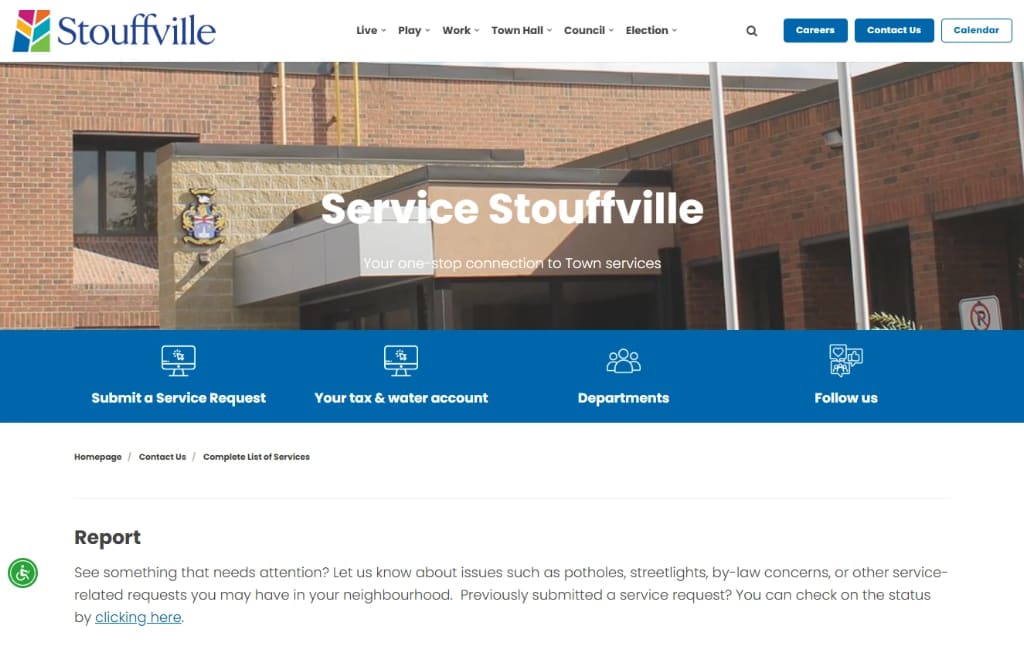
Service Stouffville's public-facing intake portal makes it easy for residents to get information on services and submit requests.
For Stouffville, building this new service system needed to go beyond solely meeting the needs of today, and consider where the Town wanted to go. They deliberately approached this from a configuration-over-customization approach to avoid becoming overly dependent on specialized development in the future.
“One key thing about the ArcGIS platform is that it’s highly configurable, meaning we could strike this balance between being able to manipulate and configure it.”
— Paul Lefaive, Data and Analytics Analyst, Town of Stouffville
Stouffville created a solution that included configured applications, workflows, dashboards and forms, which worked together to support the entire service request workflow. The public-facing service request intake experience got a makeover, complete with built-in GIS validation to check and confirm information like municipal boundaries. Once confirmed, the request then follows automated routing rules that assign requests to the appropriate department. The operational staff addressing the request are then supported by mobile and web applications that allow them to receive, update and notify when requests are complete. This work is supported by operational dashboards for managers and leaders who can now provide executive reporting and analytics to senior leadership and council.
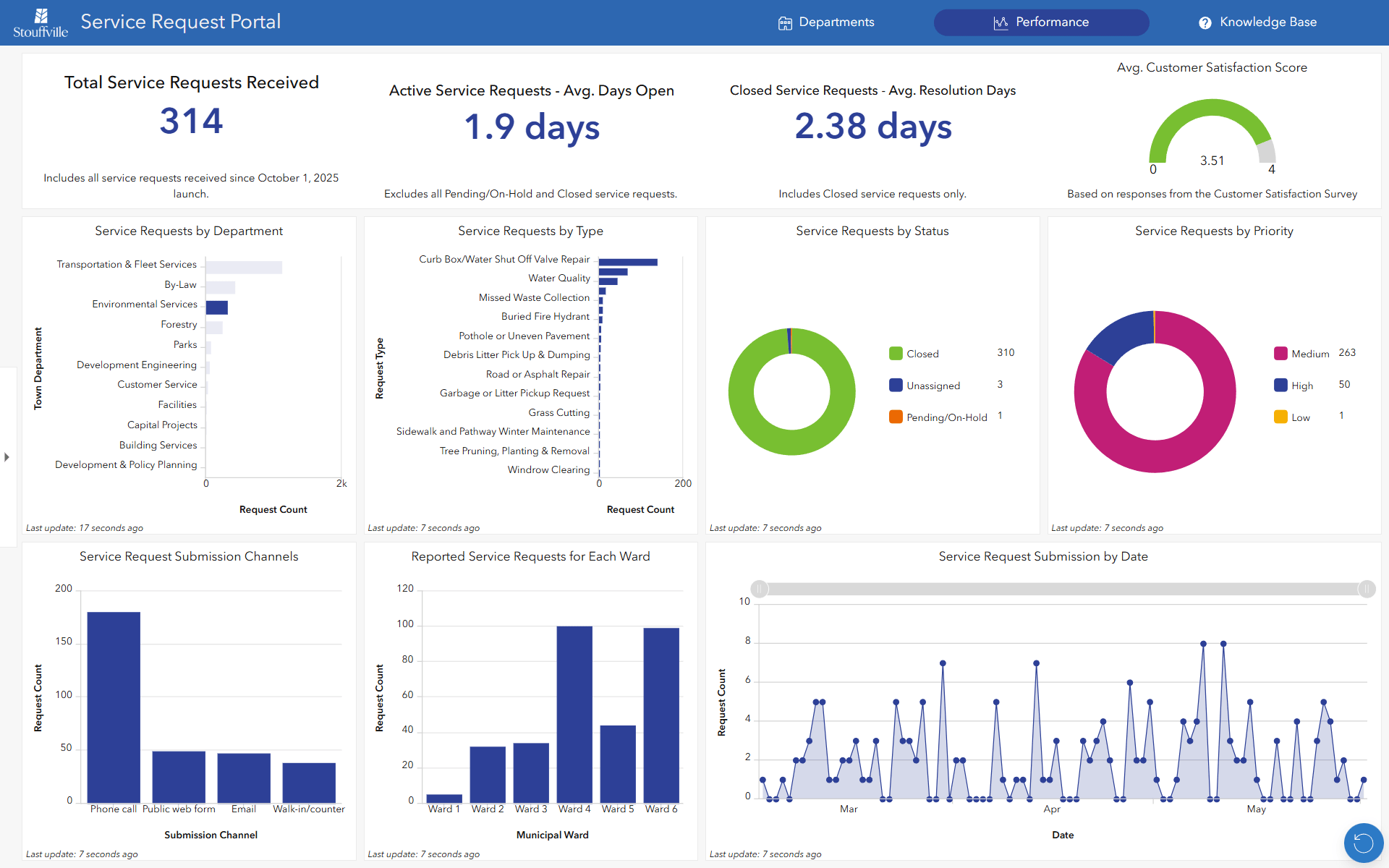
The result: faster service and better visibility
The impact of the new system was felt immediately. Since implementation, the Town has reduced service request resolution times by 37.5%, while increasing the volume of requests handled to 30% year over year. The improvements earned industry recognition, including multiple awards, conference features and more. Internally, processes and workflows were smoother and more efficient across teams.
“A moment of success that stood out to me was when a project team lead reached out to us because he was feeling concerned that he wasn't getting the same volume of service requests he was accustomed to. After reviewing the requests, it turned out it was simply that he was no longer receiving requests that were irrelevant to his department.”
— Paul Lefaive, Data and Analytics Analyst, Town of Stouffville
The benefits extend beyond internal operations. Residents can now receive updates on their requests and track progress without needing to call customer service for information. The Town estimates that this capability alone has saved more than 2,600 minutes of phone enquiries year to date. As for resident feedback, of the 157 respondents, the system received an overall satisfaction rating of three out of four.
An approach for other municipalities
Stouffville proves that innovation isn't reserved for the largest municipalities. By maximizing existing GIS investments and empowering staff to solve local challenges, communities of any size can transform how services are delivered. Smaller municipalities are often challenged to do more with less, but they can rise to the occasion and provide an incredible resident experience. By giving staff, managers and residents greater visibility into requests from start to finish, the Town transformed service delivery and created a foundation for continuous improvement.