Énergir and GIS: Inspiring young people to explore their environment with GIS
Énergir’s GIS team provided support to students in grades 3 and 5 on data collection and analysis projects that helped foster their critical thinking skills.
Caroline Lessard, Senior Director of Geomatics and Network Information at Énergir, has been reading Esri Canada’s newsletter featuring GIS projects carried out in schools for several years now, and she thought it would be wonderful to contribute to such an initiative. What made this idea even more meaningful was that Énergir has been partnering with Baril School, located in the Hochelaga-Maisonneuve neighbourhood of Montréal, for several years. A committee at the school organizes various activities to enrich students’ daily lives and provide support to students in vulnerable situations. As a director of geomatics with a passion for the many possibilities offered by geospatial technologies, Caroline also knew she could count on the enthusiasm of several colleagues eager to share their expertise and passion with the children. She was convinced of the importance of exposing young people to this discipline and opening up new opportunities for them. If her team's projects could plant a few seeds, spark curiosity or simply ignite a spark in some students, then their goal would be achieved.
Beginning in December 2025, a meeting was organized with the teachers who expressed interest.
Caroline's team member Valérie Arrelle took the lead on this project. She collaborated with her colleagues, Catherine Breton-Dufour and Louis-Simon Desjardins, on this wonderful project at Baril School.
The project's objectives were to:
- help students discover geomatics by introducing them to interactive maps and by demystifying what geomatics is in a practical and accessible way;
- encourage active learning by engaging students in a participation-based approach that provides them with real-world experience (in the field or in the classroom);
- structure analytical thinking by interpreting data, drawing conclusions and learning to work with new technical tools; and
- develop cross-functional skills like collaboration, communication, planning, coordination and creativity.
Third-grade teacher Marie-Geneviève Bonnier and fifth-grade teacher Julie Beaulac mentored the students and defined survey topics to ensure that the proposed activity aligned with curricular objectives. The Énergir team provided technical and educational support, particularly in creating ArcGIS Survey123 forms, collecting and analyzing data, as well as presenting the results using ArcGIS StoryMaps.
On March 24, 2026, the Énergir team visited Marie-Geneviève’s third-grade class and helped the students create a form and collect data for a project called “The origin of our environment”. The students had previously surveyed five people in their community using a printed form before participating in data collection and analysis in class. The following week, the Énergir team returned to share the results with the students using an ArcGIS StoryMaps story. Charts and a map showing the diversity of the backgrounds of the third-grade students’ social circles sparked a lively discussion.
The activity with Julie’s 5th-grade class focused on a completely different theme. The chosen topic was the various facilities in the neighbourhood. In early May 2026, the Énergir team visited the classroom to speak with the students and create a form in preparation for data collection. The data collection took the form of a field trip. On May 19, 2026, the 5th-grade class and the Énergir team combed the streets and parks in the area surrounding the school. Together, they took an inventory of the neighbourhood’s facilities. They observed the types of facilities available, the different types of ground surfaces (asphalt, concrete, dirt, grass, wood chips, etc.), assessed the cleanliness of the facilities’ surroundings and evaluated whether the areas were suitable for families. A total of more than 70 observation points was identified during the field trip.
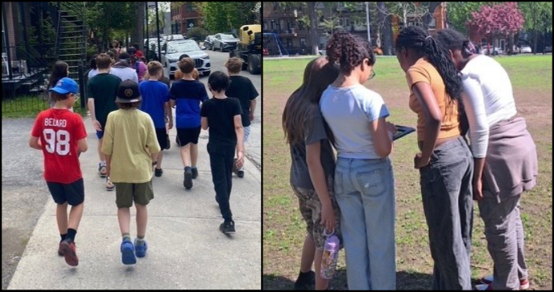
Fifth-grade students from Baril School during their field trip on May 19, 2026
On June 3, the Énergir team returned to the classroom to present the results of the data collection. Using the story Les différentes installations autour de l'école Baril (The Different Facilities Around Baril School) (in French), the students were invited to analyze their data and explore mathematical concepts such as converting percentages to fractions. The students also reflected on their approach to collecting and analyzing data:
“Would we have obtained a different ranking if our application had been better prepared and if we had taken more time to think about the facilities? If so, what would that ranking have been?”
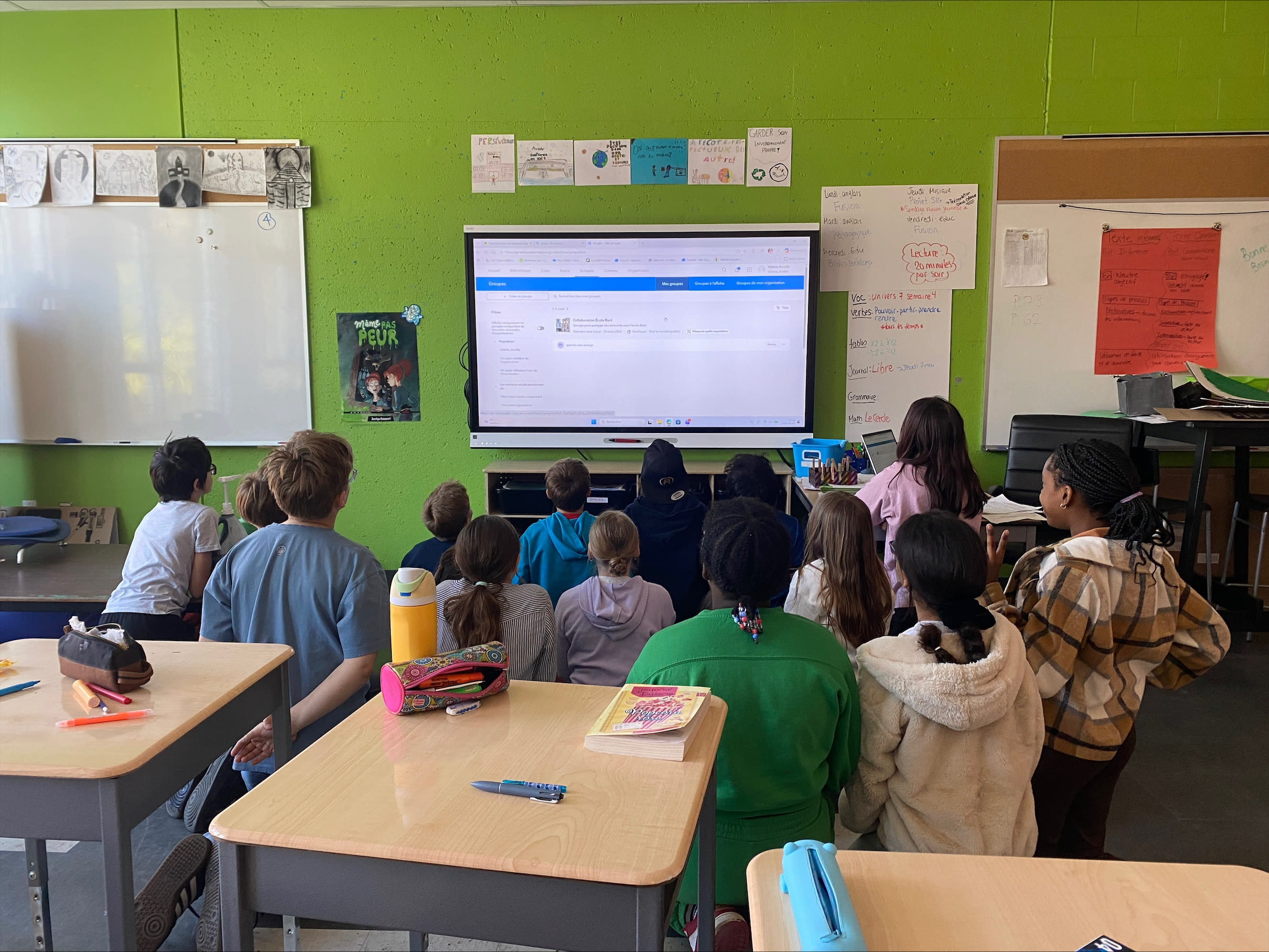
The story: Les différentes installations autour de l'école Baril (The Different Facilities Around Baril School) (in French)
The project enabled students to learn how to ask questions, collect data, read and interpret tables, calculate percentages and averages, and present information using diagrams. It also developed their critical thinking skills by encouraging them to reflect on the limitations of the data they collected (since almost all of it was gathered on the same day).
The project had the students working like real scientists: observing, analyzing, comparing and drawing conclusions based on real data. It also gave the students a chance to think about ways to improve the neighbourhood parks and make them even more enjoyable for everyone.
The students in both the 3rd-grade and 5th-grade classes showed considerable interest in the activities. The interactive and hands-on nature of the activities greatly contributed to their interest. The teachers appreciated the project’s educational value, which helped students develop skills in statistics, geography and the use of digital tools. The results also highlighted the school’s cultural diversity, which was well received by everyone.
Despite a few challenges such as unpredictable weather, logistics related to the field trip and difficulties caused by the school’s unstable Internet connection, the Énergir team nevertheless enjoyed working on this project with the teachers who participated. They hope to continue the experience in 2027 with new themes, such as compiling a list of bakeries and their signature products in Old Montréal, exploring the neighbourhood’s green alleyways or studying local sports facilities and businesses.
About Énergir
Énergir is a diversified energy enterprise whose mission is to meet the energy needs of its estimated 540,000 customers and the communities it serves in Québec and Vermont in an increasingly sustainable manner. As Québec’s leading natural gas distributor, Énergir also generates electricity from wind power in the province through joint ventures. The company operates in the United States, through subsidiaries and other investments, generating electricity from hydro, wind and solar sources, in addition to being the leading electricity distributor and the only pipeline natural gas distributor in the state of Vermont. Énergir hopes to become a sought-after and valued partner for all those who aspire to a better energy future. The Énergir team is proud to have contributed to this initiative at Baril School. This initiative fully reflects the company’s DNA: giving beyond simply donating by investing and actively engaging in communities.
Your toolbox
We’re always available to answer your questions and to guide and support you with your projects. Write to us at k12@esri.ca.
If you’d like to get started on your GIS adventure, visit our website to obtain free access for you and your students: k12.esri.ca.
For more activity ideas and a wide range of resources, visit our K12 Resource Finder.
This post was written in French by Arabelle Sauvé and can be viewed here.